Interview with Scott Peck about Community Building in organizations
More than a year ago, we set out on a journey — literally and figuratively. With the support of the Erasmus+ programme, we implemented the project “Community Building across Europe”, which brought our organisation new experiences, friendships and collaborations that reach far beyond the project itself. The project ran through the Czech National Agency Dům zahraniční spolupráce from September 2024 to February 2026. Today we share our reflections.
What We Set Out to Do
The mission of Community Building CZ is to spread the Community Building method developed by Scott M. Peck — a unique experiential approach that helps people, even in a group of strangers with very different backgrounds, uncover barriers to authentic communication and create an environment of deep mutual respect, safety and acceptance — all within just a few days. Although the method has been present in the Czech Republic since 2005, it remains relatively unknown and underused — one of the main reasons being the lack of experienced facilitators and organisers.
That is exactly what we wanted to change through this Erasmus+ project. The goal was to enable our facilitators and organisers to gain invaluable experience abroad — in environments that are culturally, linguistically and socially different from those they work in at home.
What We Experienced: 14 Mobilities in 5 Countries
Over the course of the project, we completed 14 mobilities across five countries. Each trip was different — a different environment, a different target group, different challenges and different inspirations.
France — CB for a Local Community
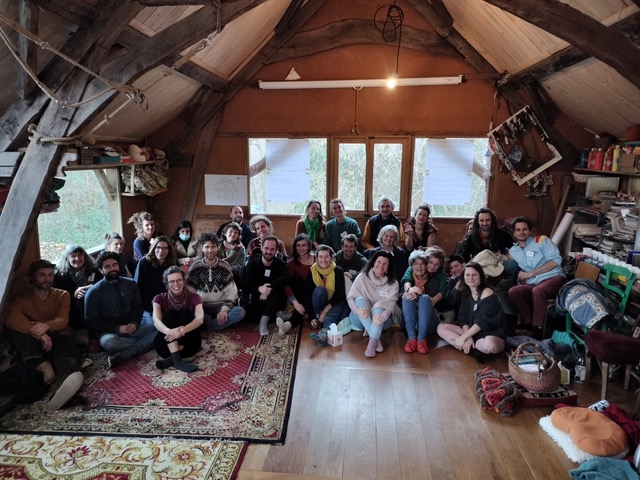
One of the most impactful trips of the entire project. Two experienced facilitators travelled to the Dordogne region, where they led a Community Building seminar for French participants for the very first time. The seminar was organised for local residents from a valley near Les Eyzies — 30 participants from the local community. The CB method is virtually unknown in France, which made this trip a pioneering experience — for our facilitators and for the hosting organisation alike. This is where the true power of CB becomes visible: the ability to create deep connection within just a few days — both among people who had never met and among those who had known each other for years and carried long-standing tensions or conflicts. The trip confirmed that CB has the potential to reach entirely new environments and communities, and that it can bridge linguistic and cultural divides.
Latvia — Stepping into One’s Own Power
Our facilitator led a CB seminar on the grounds of a former university campus in Riga — one of the most demanding environments she had ever encountered in CB. The team faced significant internal conflicts, and the whole seminar required extraordinary resilience and the courage to fully step into her own facilitator power. And yet — perhaps because of this — the seminar succeeded and sparked interest in facilitator training among Latvian participants.
The key insight: the direct and open communication style of Northern European participants was both inspiring and challenging. The experience confirmed how important it is to carefully select who enters facilitator training — team dynamics have a fundamental impact on the entire seminar.
Poland — Where CB Met Permaculture
An unplanned, yet all the more valuable stop. We connected with Leszek Frankiewicz — a permaculture designer — and his wife Joanna, a therapist. Together we discovered a world of remarkable possibilities in how permaculture and CB complement and support one another. We discussed a long-term vision: how to spread CB sustainably, how to connect the method with ecological thinking, and how to think about intentional communities. The trip was so inspiring that we are now planning several joint CB seminars for the public. This partnership is one of the greatest gifts of the entire project.
Joanna articulated something important: when deep personal connection happens in CB, it can be profoundly beneficial for people carrying trauma — but when connection fails, it becomes very difficult. This insight inspires us to think further about which target groups CB serves best and under what conditions.
Slovakia — CB and Internal Family Systems: Connecting Two Approaches
In Slovakia, one of our collaborators attended a seminar as a participant — a seminar that was unique in combining Community Building with the Internal Family Systems (IFS) approach. IFS is a therapeutic model that works with the different inner parts of our personality — voices, beliefs and patterns that influence us without our full awareness. The combination of both approaches revealed interesting synergies: CB creates a safe group space in which these inner parts can naturally surface and be received by others without judgement. The experience inspires further thinking about how to enrich CB with insights from related fields and how to offer it to people working on their inner development.
Germany — Invisible Facilitation and the Question of Safety
Two more of our participants attended a seminar led by experienced senior facilitators from the Ammersee-Institut für Communitybuilding in the Bavarian foothills of the Alps. Their facilitation style was inspiring: minimal visible interventions within the circle, but individual conversations with participants during breaks. Their facilitation was nearly invisible to the group — and yet highly effective.
This experience opened a fascinating question: where is the boundary between creating a safe space and limiting opportunities for collective learning? The seminar showed how strongly cultural context shapes group dynamics — the German group displayed a high sensitivity to safety and caution, which shaped the overall character of the gathering differently from what we were used to in Czech settings.
Hungary — The Intimacy of a Small Group
In Hungary, a women’s retreat took place — originally planned for a larger group, it ultimately ran with five participants. The intimate setting enabled deep sharing around themes of privilege, education and belonging, and confirmed that CB works even in such a small format.
The trip also brought a practical insight about interpretation: the quality of the interpreter significantly affects the seminar’s flow. An interpreter who maintains full presence and professionalism throughout allows facilitators to work with much greater freedom. Conversely, an interpreter who loses focus can disrupt group dynamics at sensitive moments.
Slovakia and Germany — Invited Experts in the Czech Republic
A Slovak senior facilitator and German senior facilitators also came as invited experts directly to the Czech Republic, where together with our facilitators they prepared and led seminars for Czech participants.
The seminar with Karol Herian was in many ways a standard CB seminar, yet it brought an important confirmation: the quality of the facilitator team — their shared process before, during and after the seminar — is essential for the outcome. A strong relationship between facilitators directly shapes the quality of the space they can create for participants. Czech participants were greatly enriched by the exceptional quality of the team.
The seminar with Simone Kosog and Alex Wiedemann was particularly interesting for the many subtle nuances of their facilitation style — enriching both for our Czech facilitator colleague and for participants from the Czech Republic and abroad alike.
What the Project Brought Us
For facilitators: Every participant broadened their experience of working in different cultural, linguistic and social environments. We encountered a wide range of facilitation styles and philosophies — from invisible facilitation to working with trauma survivors to strategic approaches to spreading the method. Everyone completed an individual reflection of their learning outcomes and received a certificate. The feedback from standard Erasmus+ participant reports speaks clearly: 100% of participants rated their mobility as beneficial, 100% reported improved practical skills and a deeper understanding of diversity in society.
For the organisation: We have a stronger team of experienced facilitators ready to reach new target groups — from faith communities to ecological movements, women’s retreats and social services settings. We have established or deepened partnerships with organisations in five European countries.
For the public: The project brought us great joy and strong motivation for new work and new possibilities. Its results are directly reflected in what we now offer you. We are already planning further seminars — in new places, for new groups, with facilitators bringing experience from across Europe. Public interest in the CB method is growing and we are ready to meet it.
What Lies Ahead
This Erasmus+ experience has convinced us that international collaboration is irreplaceable for the development of the CB method. That is why we have applied for a follow-up Erasmus+ grant, which could begin in September 2026. We are now awaiting the outcome — fingers crossed. We hope to continue our international cooperation and bring you ever higher quality CB seminars both in the Czech Republic and abroad.
This project was co-funded by the European Union under the Erasmus+ programme.
Interested in a Community Building seminar?
Browse our current dates at www.communitybuilding.live/en/events or get in touch.
Related posts
